The “Tent City” Killing Everest: How Commercial Tourism and Luxury Camps Are Liquefying the Khumbu Glacier from Within

Yellow commercial expedition tents sprawled across the Khumbu Glacier at Everest Base Camp; rising human activity and localized heat are accelerating glacial melting. | Photo: Nepal Trek Adventures via Wikimedia Commons (CC BY-SA 4.0)

The “Tent City” Killing Everest: How Luxury Base Camps and Unchecked Tourism Are Disintegrating the Khumbu Glacier | Investigation | 04 September 2026
KATHMANDU / KHUMBU BASE CAMP: Every spring, high above the clouds at 5,364 meters, an unnatural metropolis materializes on the shifting, ancient tongue of the Khumbu Glacier. What was once an austere, windswept waypoint for hardened mountaineers has morphed into a sprawling, high-consumption luxury compound. Over 1,500 expedition tents now sprawl across the ice—boasting heated carpeted floors, high-end kitchens, hot shower booths, continuous diesel generators, and satellite broadband domes. The “Tent City” Killing Everest
Behind this multibillion-dollar commercial mountaineering boom lies an unfolding, irreversible ecological breakdown. New peer-reviewed field investigations and glaciological assessments reveal that the localized thermodynamic footprint of Everest Base Camp (EBC) is actively disintegrating the Khumbu Glacier from within, compounding broader climate warming at an alarming pace.
The Unseen Thermal Shock: 6,000 Liters of Human Waste Daily
Extreme altitude demands physiological compensation: climbers and Sherpa crews must consume staggering volumes of liquids to counter dehydration and acute mountain sickness. In peak climbing seasons, an estimated 6,000 liters of human urine are generated across the camp every single day.
Expelled at core body temperature (approximately 37°C / 98.6°F) directly onto the surface ice or into rudimentary collection channels, this daily torrent of warm liquid delivers a severe, localized thermodynamic shock. According to recent glaciological modeling, this internal bodily heat alone liquefies more than 150 tons of millennia-old glacial ice each season.
While biochemical runoff is concentrated within a specific corridor, its cumulative effect disrupts the structural cohesion of the moraine, destabilizing base rock layers that take centuries to form. The “Tent City” Killing Everest
അനുബന്ധ വാർത്തകൾ


Burning the Glacier: The Luxury Carbon Footprint
While organic effluents degrade the upper crust, the primary engine of structural disintegration is the camp’s relentless reliance on fossil fuels. To sustain modern comforts in sub-zero conditions, commercial operations burn through colossal supplies of combustible energy:
- Heavy commercial Liquefied Petroleum Gas (LPG) cylinders for continuous meal prep and snow melting.
- Kerosene heaters warming communal lounges and VIP sleeping quarters.
- Petrol and industrial diesel generators operating day and night to keep electronics charged and high-altitude communications active.
Empirical thermographic monitoring reveals that fossil fuel combustion generates more than 90 percent of all localized artificial heat at Everest Base Camp. This continuous burn accounts for an estimated 2,500 tons of localized seasonal ice melt.
Researchers monitoring the Khumbu tongue document that localized ambient temperatures across the base camp sector are rising up to 0.25°C faster each year than adjacent, unpopulated glacial zones. This microclimatic warming compounds an already dire crisis: regional satellite tracking indicates that overall ice volume loss across the Himalayas has doubled since 2000.
The Downstream Peril: Glacial Lake Outburst Floods (GLOFs)
The localized liquefaction of the Khumbu Glacier is not a self-contained phenomenon; it is a direct hazard to downstream mountain communities. Accelerated meltwater carves unstable englacial conduits and deep caverns beneath the moraine, pooling into perched glacial lakes held back only by loose rock and crumbling debris.
When these unstable natural dams collapse under internal hydraulic pressure, they unleash catastrophic Glacial Lake Outburst Floods (GLOFs). Recent surge floods down the Dudh Kosi river basin have destroyed critical footbridges, wiped out small mountain settlements, and taken hundreds of lives across high-altitude villages.
For the millions of indigenous inhabitants living downstream across Nepal, northern India, and the border valleys of China, the commercial expansion of Everest’s upper slopes poses an escalating, direct threat to life, property, and freshwater security. The “Tent City” Killing Everest
The Relocation Deadlock: Policy Paralyzed by Profit
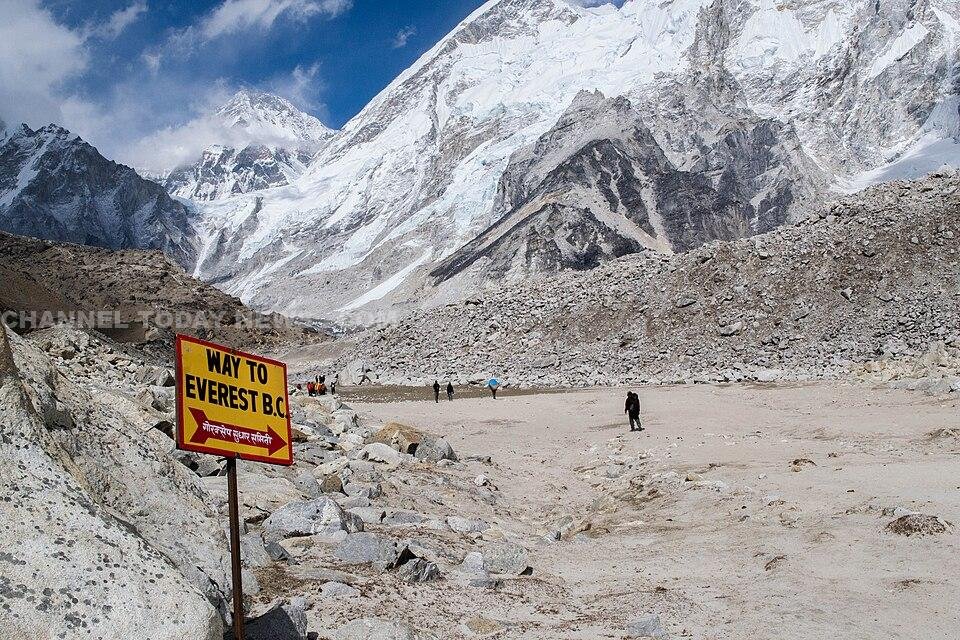
Faced with alarming scientific degradation data, environmental authorities and Nepal’s Department of Tourism previously evaluated plans to relocate Everest Base Camp to a lower, non-glacial site near Gorak Shep (roughly 200–300 meters lower in elevation). Yet years after initial proposals, the relocation strategy remains in regulatory paralysis.
Commercial expedition outfits, high-altitude logistics cartels, and sector lobbyists have consistently pushed back against relocation, citing operational bottlenecks:
- Safety Risks on the Khumbu Icefall: A lower base camp lengthens the approach through the lethal Khumbu Icefall, increasing exposure to serac collapses and crevasse falls during predawn ascents.
- Displacing Ecological Impact: Shifting the base camp footprint risks turning previously stable subalpine terrain into a new high-altitude dumping zone.
The Urgency for Enforceable Oversight
Leading high-altitude environmental scientists caution that nominal relocation plans mean little without radical operational restrictions on the mountain itself:
- Total Fossil Fuel Phaseout: Mandating solar-thermal arrays, low-emission electrical systems, and ending unregulated generator combustion.
- Strict Expedition Caps: Limiting annual foreign climbing permits rather than expanding quotas for fiscal windfalls.
- Rigid “Pack-It-In, Pack-It-Out” Mandates: Requiring all human, organic, and gray-water waste to be barrel-sealed and evacuated completely from the Khumbu watershed via rotary airlift.
As long as the world’s most iconic mountain is run like a high-altitude amusement park, its foundations will continue to melt out from underneath it. Preserving the Khumbu Glacier requires moving beyond voluntary guidelines to enforceable, zero-tolerance conservation policy.
For continued investigations and global environmental reports, visit Channel Today News (channeltodaynews.com).